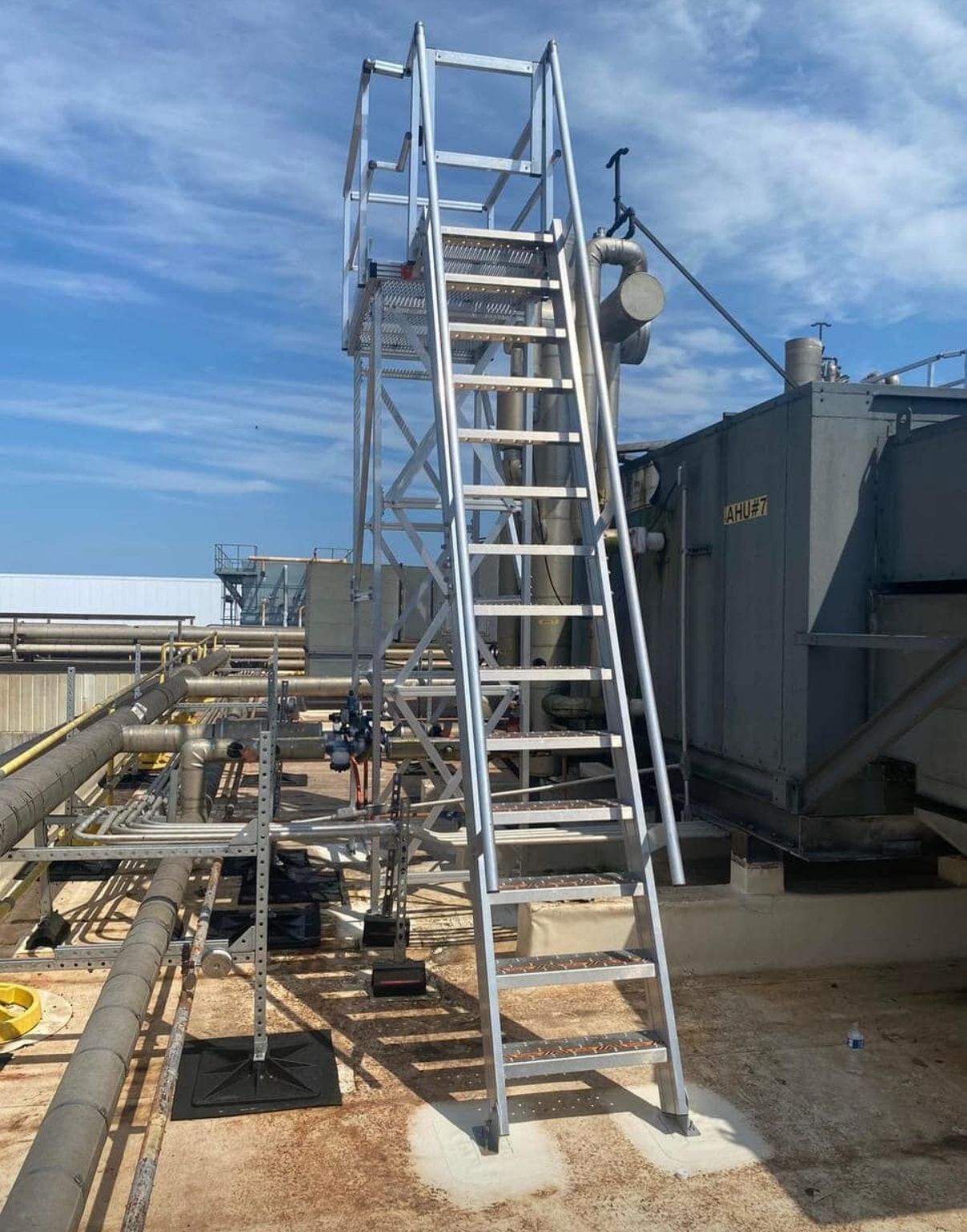
Access solutions are rarely one-size-fits-all. In many environments, traditional staircases take up too much room, while vertical ladders may not provide the balance of accessibility and practicality required for regular use. This is where ships ladder design becomes particularly effective, offering a middle ground that combines compact structure with improved usability across a wide range of industries.
Rather than being limited to marine settings, ships ladders are now commonly found in commercial, industrial, and maintenance-focused environments where space efficiency matters just as much as safe access.
Industrial Facilities
Industrial buildings often contain elevated platforms, machinery access points, and mezzanine storage areas that need to remain reachable without sacrificing floor space.
Ships ladders work well in these situations because their steeper angle allows them to occupy a smaller footprint than conventional stairs. This makes them useful in facilities where every metre of operational space matters.
Common industrial uses include:
- Access to machinery platforms
- Maintenance routes to elevated systems
- Mezzanine and storage access
Because these environments are often fast-paced, permanent and reliable access becomes essential. Ships ladders provide a practical route without requiring large structural changes.
Rooftop and Plant Access
Modern buildings frequently require safe access to rooftop systems such as HVAC units, ventilation equipment, and maintenance zones.
Traditional staircases may not be practical in these areas due to limited internal space. Ships ladders provide a more compact alternative while still offering a more comfortable climbing angle than vertical ladders.
In these applications, additional features are often included:
- Handrails for stability
- Slip-resistant treads
- Durable weather-resistant materials
This combination makes them suitable for both indoor and outdoor installations.
Marine Environments
Although ships ladders are now used far beyond the marine industry, their origins still explain much about their design.
On vessels, space has always been limited. Access systems needed to be steep enough to conserve room while still remaining manageable during regular movement between levels. This balance shaped the angled ladder style that is still widely used today.
Marine environments continue to rely on these systems because they provide:
- Efficient movement between compact levels
- Strong durability in demanding conditions
- Stable access in confined layouts
The principles developed for ships have since transferred naturally into land-based industries facing similar space constraints.
Commercial and Warehouse Spaces
Warehouses and commercial properties increasingly use mezzanine floors and elevated storage systems to maximise available space.
In these settings, ships ladders offer a practical access solution without consuming large floor areas. Their compact profile makes them especially useful in buildings where operational efficiency depends on preserving as much usable space as possible.
Unlike fixed vertical ladders, they also provide a more natural climbing position for users who require regular access throughout the working day.
A Balance Between Space and Accessibility
What makes ships ladders particularly effective is their balance. They are steeper than stairs but easier to navigate than vertical ladders. This allows them to bridge the gap between accessibility and space-saving design in a way that few other access systems can.
Their adaptability also contributes to their popularity. Depending on the environment, designs can vary in material, tread style, width, and safety features to suit specific operational needs.
Why Their Use Continues to Grow
As buildings become more space-conscious and operational layouts more compact, the demand for efficient access systems continues to increase.
Ships ladders answer a very specific challenge: how to maintain practical access where traditional stairs are not realistic. Whether in industrial plants, warehouses, rooftops, or marine settings, their design continues to prove effective because it solves that challenge without unnecessary complexity.
In the end, their value lies not in appearance, but in function—providing dependable access exactly where space is limited but usability still matters.